
Interior designer furniture markup calculator
Use this furniture markup calculator to see what a client pays and how much gross profit remains. Enter retail price, trade discount, freight and receiving. Add more items to calculate a room total.
Your room estimate
- Client price before tax
- —
- Total landed cost
- —
- Gross profit
- —
- Gross margin
- —
Markup applies to product cost, freight and receiving. Tax and design fees are excluded.
Currency changes the display only.
A worked furniture pricing example
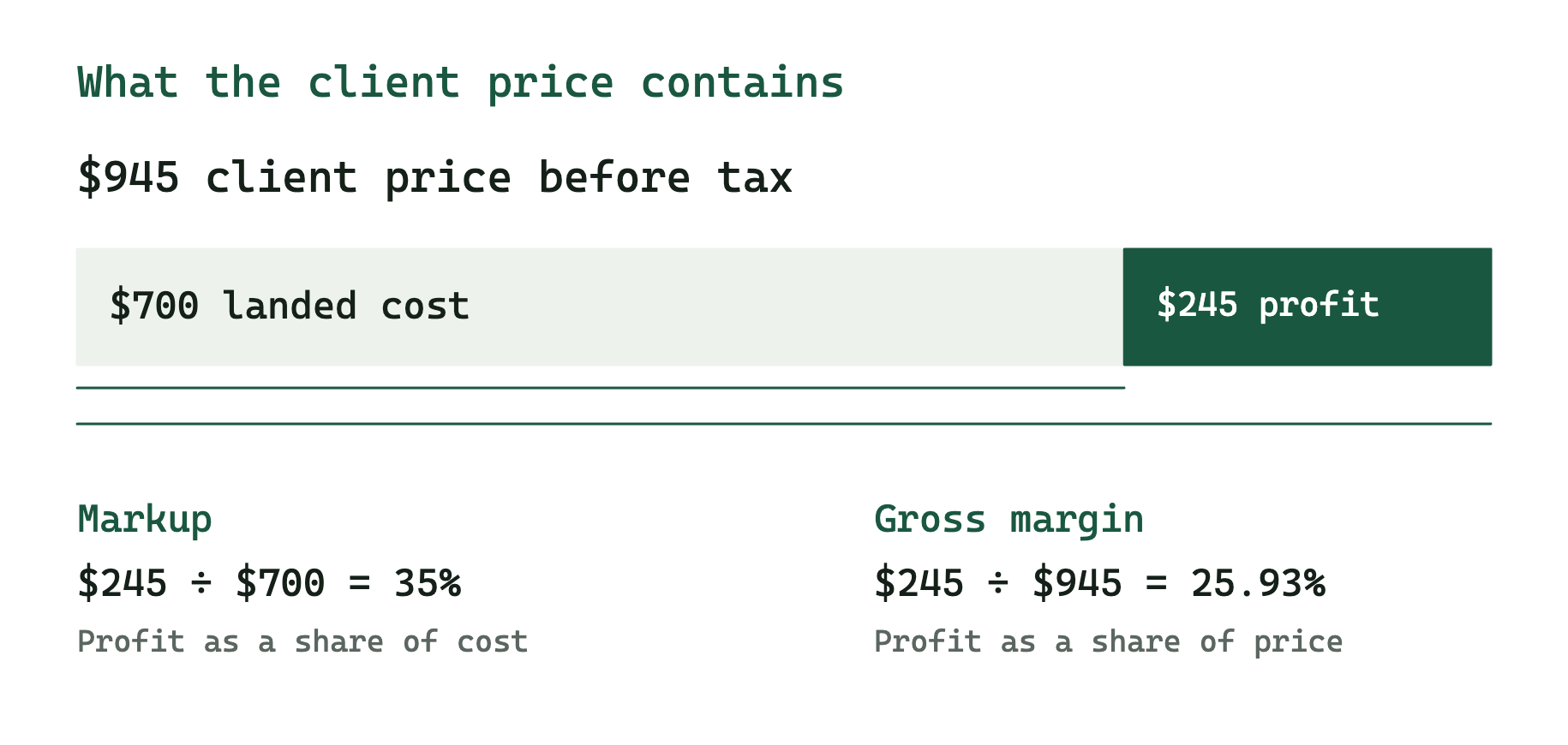
Suppose a chair lists for $1,000 and your trade discount is 40%. Your product cost is $600. Add $80 freight and $20 receiving, and the landed cost is $700. A 35% markup on that cost produces a $945 client price before tax.
| Calculation | Example |
|---|---|
| Product cost = retail price × (1 − discount) | $1,000 × 0.60 = $600 |
| Landed cost = product cost + freight + receiving | $600 + $80 + $20 = $700 |
| Client price = landed cost × (1 + markup) | $700 × 1.35 = $945 |
| Gross profit = client price − landed cost | $945 − $700 = $245 |
| Gross margin = gross profit ÷ client price | $245 ÷ $945 = 25.93% |
These are illustrative prices. Gross profit still has to cover the studio's other costs, including staff time and overhead.
Markup and margin use different bases
Markup measures profit as a percentage of your cost. Gross margin measures profit as a percentage of your selling price. In the example, $245 is 35% of the $700 cost and 25.93% of the $945 sale.
To calculate a price from a target margin, divide landed cost by one minus the margin. A $700 landed cost with a 30% target margin gives $700 ÷ 0.70 = $1,000. That price corresponds to a 42.86% markup, rounded to two decimals.
The room's margin uses total gross profit divided by total client price. Averaging individual item percentages can give the wrong result when items have different prices.
How to use the calculator
- Enter the retail unit price and trade discount. If you already have a net supplier price, enter it as the price and set the discount to zero.
- Enter quantity and line charges. Freight and receiving apply to the entire line. For six chairs in one shipment, enter the shipment charge once.
- Choose a markup. This calculator applies it to the full landed cost. If your agreement treats freight or receiving differently, calculate those charges separately using that agreement.
- Add the remaining items. Allocate shared delivery charges once across the relevant lines. Check the total client price and gross profit together.
The calculator rounds discounted unit cost and each line's selling price to cents. It adds the line results to calculate the room total. All calculations run in your browser.
Questions designers ask
What markup should I use?
Choose it from your agreed pricing model and the costs of serving the project. The 35% starting value is a calculation example. Use the interior design pricing guide to compare fee models, then document your chosen approach in the client proposal .
Does a trade discount automatically become profit?
The discount lowers your purchase cost. Your client price and the remaining project costs determine your profit. If you pass on the full discount and charge a separate purchasing fee, record the fee separately.
Does the result include tax or design fees?
The result shows the product selling price before tax and separate design fees. Add applicable tax and agreed fees through your invoicing process. Currency selection changes the symbol and code without converting the amounts.
Where do these numbers go in a project?
Keep quantities and item references in the FF&E schedule . Check supplier quotes and delivery charges as part of procurement , then carry the agreed client prices into the proposal.